
Tallow skincare is skincare made using tallow — rendered beef fat — as an ingredient.
At Hayes Meadow, our tallow starts with one particular fat: suet, the firm fat found around the kidneys. We use only this fat for our tallow. We do not use butchery trimmings or fat collected from other parts of the animal.
Suet is the raw material. Tallow is the ingredient we make from it. Tallow skincare is the finished formulation.
Sometimes tallow is used on its own. More often, it forms the base of a balm, soap or another formulation alongside ingredients chosen for a particular purpose, texture and skin feel. That is a better place to start than treating tallow as a miracle ingredient. The source and preparation of the tallow matter, but so does what it is formulated with and how the finished product is actually used.
What is tallow?
Tallow is fat that has been rendered so the usable fat can be separated from the water and solid material naturally present in the starting tissue.
Once prepared, it is usually firm at ordinary room temperature.
Tallow is made mostly of fats. Its fatty-acid profile includes stearic, palmitic and oleic acids, and these help give it the physical characteristics that make it useful in products such as balms.
Research supports describing tallow as a lipid-rich formulation ingredient, but that does not mean it should be described as “bioidentical” to human skin or automatically better absorbed than other moisturising ingredients. Direct research on topical beef tallow remains limited.
In practical terms, tallow is simply a particular fat with useful formulation properties.
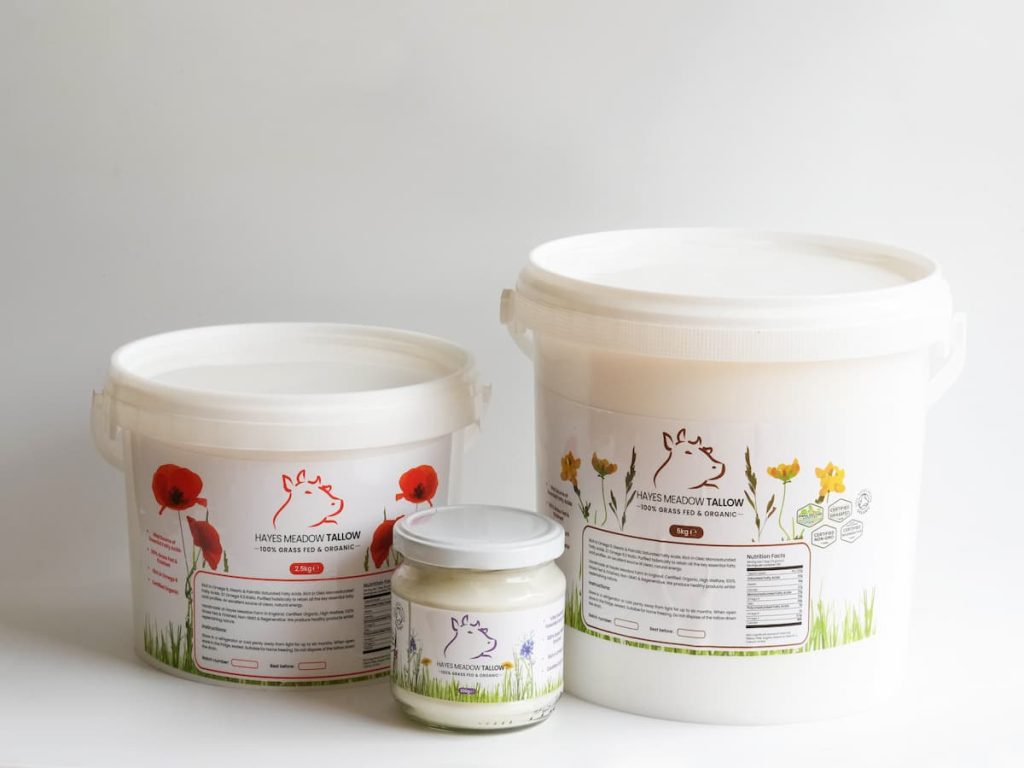

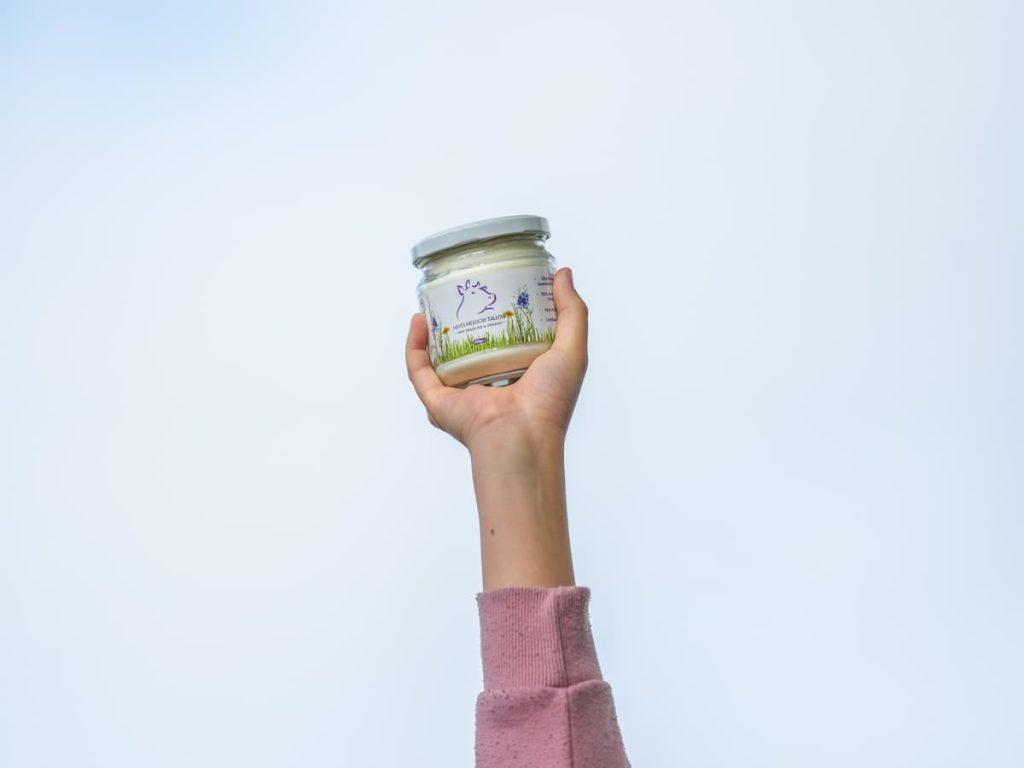

How does fresh suet become tallow for skincare?
Not all beef fat is the same, and not all tallow begins with the same raw material.
Hayes Meadow uses suet only — the firm fat surrounding the kidneys. It is separated during dressing at the abattoir rather than collected later as butchery trimming.
We collect the suet from the abattoir the day after dressing, in a refrigerated vehicle. Once it reaches Hayes Meadow, we hold it at 1°C for 24 hours before processing.
From there, the process has several stages.
Collection and chilling. The suet remains a clearly identified food-chain raw material and is kept cold once it enters our custody.
Rendering. The usable fat is separated from the water and other natural material present in the suet.
Purification. We then purify the tallow in house before it enters our products.
Storage and handling. Like other fats and oils, tallow can be affected by heat, oxygen, storage and time, so careful handling continues after rendering.
Formulation. The finished tallow can then be used on its own or as an ingredient in a balm, soap or another skincare formulation.
“Made with tallow” only tells you part of the story.
It does not tell you what fat was used, how it was handled before rendering, how it was purified or what else went into the finished product.
That is where provenance becomes useful.
Why is tallow used in skincare?
Tallow can provide the rich fat base of a balm.
In a formulated balm, tallow provides the rich fat base while ingredients such as rosehip seed oil help create a softer, more spreadable product. Used in a small amount and massaged in, the Hayes Meadow balm absorbs well in use while still leaving an emollient layer that helps dry-feeling skin feel softer and more comfortable.
Tallow also gives body to a formulation. It affects how a balm spreads, settles and feels when you use it.
Those are useful qualities without needing to claim that tallow penetrates deeply, “matches” human skin or clinically repairs the skin barrier.

Tallow can be a very useful skincare ingredient. But an ingredient is not a finished product.
What matters is how it has been prepared, what it has been formulated with and what the finished product is designed to do.
Pure tallow or a formulated balm?
Pure tallow can be useful when someone wants a single-ingredient product. A formulated balm has a different purpose. By combining tallow with carefully chosen supporting ingredients, the texture, spreadability, skin feel and practical use of the finished product can be changed.
At Hayes Meadow, we formulate because we want the finished product to do a particular job, rather than expecting one ingredient to do everything on its own. Every ingredient earns its place.
Related guide: Pure Tallow or a Formulated Balm: What Is the Difference?
Does tallow skincare smell of beef?
It should not smell strongly of beef.
The smell of tallow depends on the starting material, how it has been handled, how it is rendered and purified, how it is stored, and what else is included in the finished formulation.
At Hayes Meadow, we start with identified food-chain suet, keep it chilled before processing, and render and purify the tallow in house. The aim is a clean, mild base suitable for skincare rather than the stronger beef aroma people may associate with cooking fat.
A finished balm may also contain other oils or aromatic ingredients, so the scent of the skincare is not simply the scent of tallow itself.
Because this is one of the most common concerns for people trying tallow skincare for the first time, we cover it in more detail in Does Tallow Skincare Smell of Beef?
How do you use tallow skincare?
How you use tallow skincare depends on the finished product.
For a tallow balm, start with a small amount. Rich formulations often need less product than a light lotion or cream.
Warm the balm between your fingers if needed, then massage it into the skin until absorbed. Add more only if the skin still feels dry.
At Hayes Meadow, our balms are designed for practical everyday use on the hands, face and body. They can be used when the skin feels dry, after washing or bathing, or as part of a regular morning and evening routine. The important point is not to assume that every product containing tallow should be used in the same way. A pure tallow product, a formulated balm and a tallow soap all have different purposes.
Use the finished product according to what it has been formulated to do.
What should you look for when choosing tallow skincare?
Start by looking beyond the word tallow on the label.
A useful product should make it clear what it is made from, whether it is pure tallow or a formulated product, what the other ingredients are doing, what the product is intended for, and what the maker is actually claiming it will do.
Provenance and processing matter too. If a brand talks about the quality of its tallow, it should be able to explain where the fat comes from, how it is handled and how it is prepared.
But provenance is not the same thing as proof of skincare performance.
The same applies to fatty acids, vitamins and other naturally occurring components. Their presence can help explain the composition of an ingredient, but it does not automatically prove that a finished product will treat a skin condition or outperform another moisturiser.
Be cautious around claims that tallow is “bioidentical” to human skin, heals eczema or psoriasis, repairs wounds, or is automatically superior because it is grass-fed, minimally processed or rich in particular nutrients. A better question is:
What is this product made from, how has it been formulated, and what is it realistically designed to do?
That is the standard Hayes Meadow applies to its own products too.
How Hayes Meadow approaches tallow
For Hayes Meadow, tallow is not a bought-in commodity ingredient.
We start with identified, certified-organic food-chain suet — the firm fat surrounding the kidneys — and we use only this fat for our tallow. We do not use butchery trimmings or fat collected from other parts of the animal.
We collect the suet from the abattoir the day after dressing in a refrigerated vehicle. Back at Hayes Meadow, we hold it at 1°C for 24 hours before beginning our own rendering and purification process.
We then render and purify the tallow in house before it enters our skincare formulations.
That gives us direct oversight of:
- the type of fat we start with;
- its collection and chilled handling once it enters our custody;
- rendering and purification;
- batch traceability;
- and the point at which that tallow enters the finished formulation.
This is where Hayes Meadow’s farm and production story provides useful proof.
It does not mean we claim that fresh suet tallow is automatically better for skin than every refined or commercially supplied tallow. Current evidence does not establish that. The defensible advantage is control, traceability and process knowledge, not an unproven claim of superior skincare performance.
What we can say confidently is that we know what our starting material is, where it has come from, that it is certified organic, and how it has been handled before it reaches the finished product.
That matters to us because formulation starts before the ingredients are blended together. The quality and handling of the ingredients are part of making the product properly.
But provenance is still supporting proof.
The skincare itself has to stand on the quality and purpose of the finished formulation.
What does the research actually say about tallow skincare?
There is growing interest in tallow skincare, but the amount of direct research on finished tallow products used on human skin is still limited.
That distinction matters because a great deal of the discussion around tallow online moves very quickly from what the ingredient contains to what people assume it must do on the skin.
The research gives us a more measured picture.
Tallow is a fat made largely from triglycerides. Its fatty-acid profile commonly includes stearic, palmitic and oleic acids, which help explain why it can work well as the rich fat component of a balm or other emollient formulation. Hayes Meadow’s own independent laboratory testing also confirms these as the dominant fatty acids in our tallow.
There is also formulation research showing that tallow and tallow-based fat blends can be used successfully in cosmetic emulsions and other topical products. This helps explain how tallow can function in a formulation.
What it does not automatically tell us is how a particular finished product will perform on a particular person’s skin.
A 2024 scoping review looked at the available research on tallow and skin. It found that there were some potentially useful findings around tallow and formulations containing tallow, but also significant gaps in direct human research. Much of the evidence came from formulation studies, laboratory work, animal studies or products containing other ingredients alongside tallow rather than robust clinical trials of pure beef tallow skincare.
So the evidence currently supports a practical description of tallow as a lipid-rich skincare ingredient with useful emollient and formulation properties.
It does not currently justify saying that beef tallow:
- is bioidentical or almost identical to human skin;
- automatically penetrates more deeply than other moisturising ingredients;
- treats eczema, psoriasis or dermatitis;
- heals wounds or cracked skin;
- is inherently non-comedogenic;
- or is clinically superior to other moisturisers simply because it is tallow.
Hayes Meadow’s research register takes the same approach: ingredient composition can help us explain why an ingredient has a place in a formulation, but it should not be turned into a medical or therapeutic claim for the finished product without direct evidence.
The same caution applies to provenance.
Fresh, identified suet and careful processing give Hayes Meadow much greater control over the starting material, handling and traceability of our tallow. That is meaningful evidence of quality and provenance.
It is not proof that our tallow must therefore moisturise skin better than every refined or commercially produced tallow. No good direct clinical comparison currently establishes that.
So our position is deliberately simple:
Tallow is a useful skincare ingredient. The finished formulation matters more than the hype around any single ingredient.
We explain what we know, describe what our products are designed to do, and keep the claims proportionate to the evidence.
Tallow skincare in simple terms
Tallow skincare begins with beef fat, but what fat is used, how it is handled and how it is formulated all matter.
At Hayes Meadow, we start specifically with certified-organic food-chain suet — the firm fat surrounding the kidneys. We do not use butchery trimmings or fat collected from other parts of the animal.
We collect that suet from the abattoir the day after dressing in a refrigerated vehicle, hold it at 1°C for 24 hours, then render and purify it ourselves before it enters our skincare formulations.
That gives a simple three-stage journey:
Suet → tallow → skincare formulation.
The suet is the raw material.
The tallow is the ingredient we make from it.
The skincare is the finished product.
Tallow provides the rich fat base of the formulation. In a balm, supporting ingredients such as rosehip seed oil can change the texture, spreadability and skin feel of the finished product. Used in a small amount and massaged in, a well-formulated balm can absorb well while still leaving an emollient layer that helps dry-feeling skin feel softer and more comfortable.
Where the suet comes from and how it is handled tells you about provenance, traceability and process control.
How the resulting tallow is formulated tells you what the finished skincare is designed to do.
At Hayes Meadow, both matter.
But we do not confuse provenance with proof of skincare superiority, or turn one useful ingredient into a cure-all. Current research on topical beef tallow is still limited, so we keep our claims practical and proportionate to the evidence.
Practical skincare, properly made.