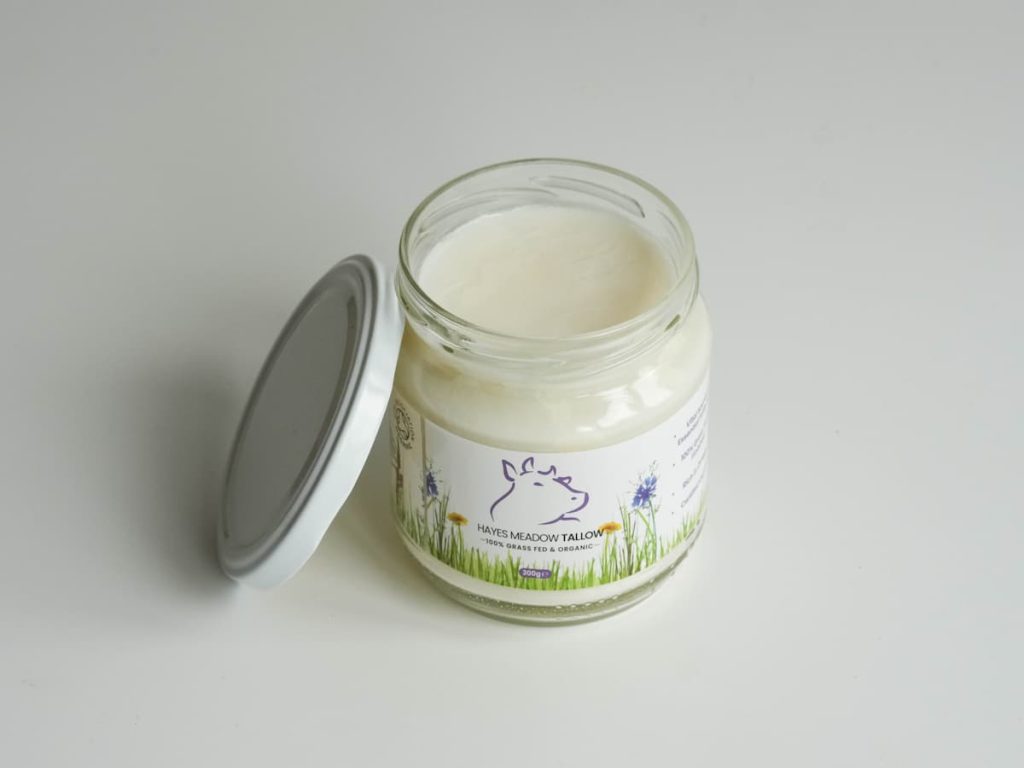
If you are interested in tallow skincare, you will quickly come across two different types of product: pure tallow and skincare formulated with tallow.
They are not the same thing.
Pure tallow gives you a single ingredient. A formulated balm uses tallow as part of a finished product, alongside other ingredients chosen to change how that product feels, spreads and works in everyday use.
Neither approach is automatically right or wrong.
The useful question is:
What do you want the finished product to do?
Can you use beef tallow on its own?
Yes. Pure tallow can be used on the skin by people who want a simple, single-ingredient product.
Tallow is a lipid-rich fat. Its fatty-acid profile includes stearic, palmitic and oleic acids, which help give it the rich texture and physical properties that make it useful in skincare formulations.
But using an ingredient on its own is different from using a product that has been formulated specifically for skincare.
That distinction is important.
Tallow is an ingredient. A tallow balm is a formulation.
The current research supports describing tallow as a useful lipid-rich formulation ingredient, but direct clinical research on topical beef tallow remains limited. It does not support broad claims that pure tallow is automatically better absorbed, inherently non-comedogenic or superior to other moisturising ingredients.

What is a formulated tallow balm?
A formulated balm starts with tallow and combines it with other carefully selected ingredients.
Those ingredients are not there simply to make the ingredient list longer.
They can change practical qualities such as:
- firmness;
- spreadability;
- how much product is needed;
- how easily it massages into the skin;
- skin feel after application;
- and, depending on the formulation, scent and intended use.
That is why we think it is more useful to judge the finished formulation than to assume that the shortest possible ingredient list must always make the best skincare.
Why does Hayes Meadow formulate its tallow?
Pure tallow can be useful when somebody wants a single-ingredient product.
A formulated balm has a different purpose.
By combining tallow with carefully chosen supporting ingredients, the texture, spreadability, skin feel and practical use of the finished product can be changed.
At Hayes Meadow, we formulate because we want the finished product to do a particular job, rather than expecting one ingredient to do everything on its own.
Every ingredient earns its place.
That principle matters more to us than adding ingredients for fashion, complexity or marketing.
What does rosehip seed oil add to a tallow balm?
Rosehip seed oil is one of the purposeful supporting ingredients we use in our tallow skincare.
It is a lighter liquid oil, so incorporating it into a tallow balm changes the character of the finished formulation. It helps create a softer, more spreadable product than tallow on its own.
Used in a small amount and massaged in, our tallow–rosehip balm absorbs well in use rather than simply feeling like a solid layer of fat sitting on the skin.
Rosehip seed oil also contributes unsaturated fatty acids, including linoleic and alpha-linolenic acids, to the formulation.
What we do not claim is that rosehip somehow carries tallow deep into the skin or proves that the finished balm has therapeutic effects. Research on rosehip seed oil exists, but ingredient research cannot automatically be transferred to the Hayes Meadow finished formulation.
For us, the more useful point is practical:
the tallow and rosehip are formulated together to create the finished balm we want people to use.
Is pure tallow heavier than a balm?
different.
Pure tallow is naturally firm at room temperature and its texture changes with temperature. Depending on the amount used, where it is applied and the individual product, some people may find a pure fat richer or heavier than a formulated balm.
That does not mean pure tallow inevitably leaves a waxy film or blocks pores.
Those were overly broad claims in the previous version of this page and we are not carrying them forward.
Skin type, amount applied, the particular tallow and the rest of a formulation can all affect how a product feels in use. This is one reason we recommend starting with a small amount of any rich balm and adding more only if needed.
Does a longer ingredient list make a balm better?
No.
More ingredients do not automatically make better skincare.
Nor does having only one ingredient automatically make a product better.
The better question is whether each ingredient has a clear purpose.
A simple formulation might contain only a handful of ingredients but still behave quite differently from any of those ingredients used individually.
At Hayes Meadow, that is how we think about formulation: not as adding complexity, but as choosing ingredients that make sense together.
What about the quality of the tallow itself?
Formulation matters, but the starting ingredient still matters too.
Hayes Meadow starts with identified, certified-organic food-chain suet — the firm fat surrounding the kidneys. We use only suet for our tallow, rather than general butchery trimmings or fat collected from other parts of the animal.
We collect the suet refrigerated from the abattoir the day after dressing, hold it at 1°C for 24 hours, and then render and purify the tallow in house before it enters our formulations.
That gives us control and traceability over an ingredient that sits at the centre of our skincare.
It does not prove that our tallow must therefore work better on skin than all other tallow. The current evidence does not support that comparison. Hayes Meadow’s provenance work deliberately treats raw-material control as supporting proof of how the product is made, rather than as the skincare claim itself.
So which should you choose: pure tallow or a formulated balm?
It depends on what you want.
If you specifically want one ingredient and are happy with the natural texture and behaviour of pure tallow, a pure product may suit you.
If you want a product designed around qualities such as spreadability, absorption in use, skin feel and regular face, hand or body application, a formulated balm may be the more practical choice.
Neither decision needs a miracle story behind it.
The important thing is to understand what you are buying.
Pure tallow is an ingredient used on its own.
A tallow balm is a finished formulation designed around a particular use.
At Hayes Meadow, we choose the second approach for our skincare because formulation allows us to make the product we actually want to use: practical, straightforward skincare in which every ingredient has a reason for being there.
Practical skincare, properly made.

Just recieved my vanilla face and body balance and sandlewood and ylang ylang soap bar. Both smell absolutely beautiful, which was a relief, the last tallow products I purchased elsewhere had a really strong beefy smell. I haven’t tried the soap bar yet but the face and body balm is brilliant. You only need a little and it absorbs brilliantly and has left my skin soft, not greasy and smells great. Thank you, officially hooked!
Thank you so much for your lovely comment. This is very kind of you.